OFAC Screening for Vendors
Why the list alone is not enough
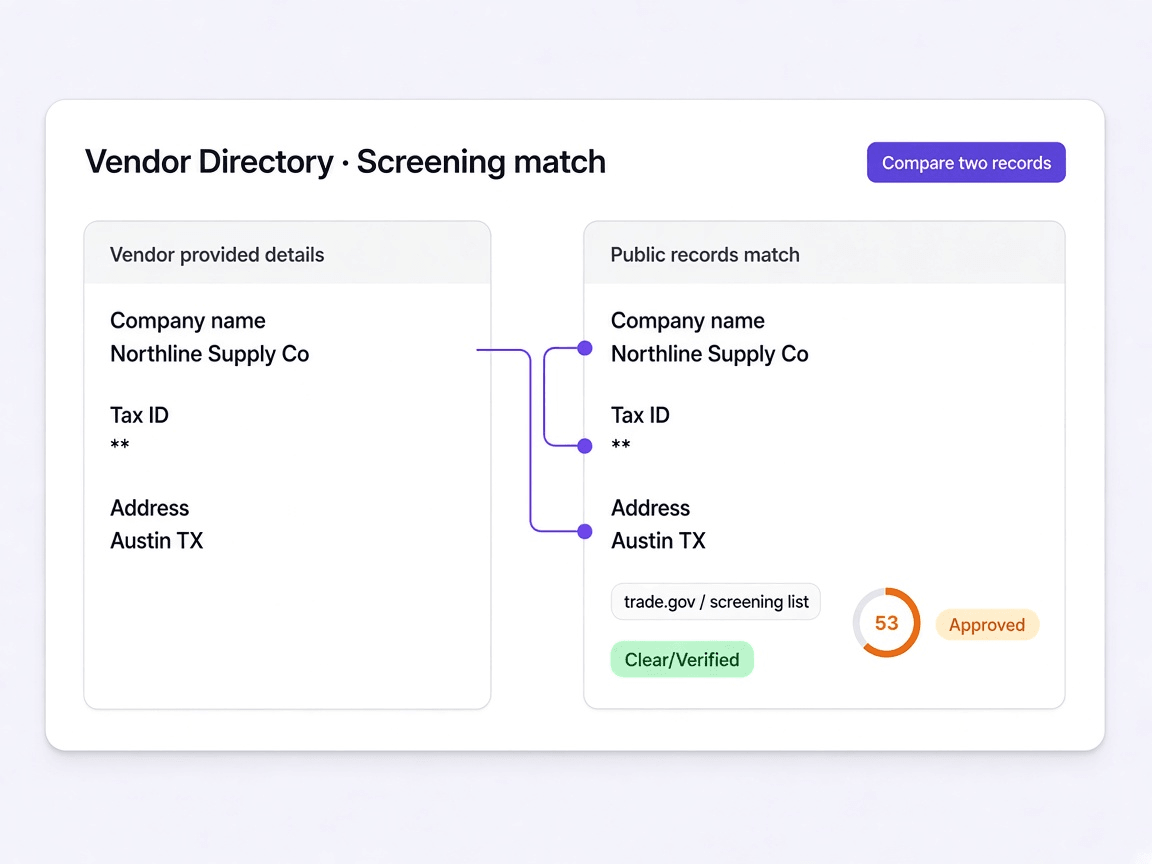
Screening a vendor name against the SDN list feels like the whole job. It is roughly half of it, because the entities that cause problems are frequently not on the list themselves.
OFAC screening means checking counterparties against the Specially Designated Nationals list and other applicable sanctions lists before transacting. Name screening alone is insufficient, because under OFAC's 50 percent rule an entity owned 50 percent or more by blocked persons, directly or indirectly, is itself blocked even though it never appears on the list. Ownership must be aggregated across all blocked owners.
Ownership, aggregated
The aggregation point is where most programmes fall short, because each individual stake can look harmless on its own.
| Element | How it works |
|---|---|
| The threshold | An entity owned 50 percent or more by one or more blocked persons is treated as blocked itself |
| Aggregation | Stakes held by different blocked persons are added together. Two blocked parties holding 25 percent each reaches the threshold |
| Indirect ownership | Ownership held through intermediate companies counts, which is why layered structures need to be traced rather than taken at face value |
| Across programmes | Blocked persons designated under different sanctions programmes still aggregate against the same entity |
| Not published | OFAC does not publish a list of entities blocked solely by the 50 percent rule, so screening the SDN list will never reveal them |
Four things a screening programme needs
Fuzzy matching rather than exact
Name variations, aliases and transliterations mean exact match screening misses genuine hits. Fuzzy logic produces more possible matches, which is the correct trade.
Beneficial ownership questions at onboarding
Ask the vendor to disclose beneficial owners and any known links to sanctioned parties. You cannot trace ownership you never asked about.
A human reviewing possible matches
Name similarity is common and genuine matches are rare, so automatic blocking stops legitimate vendors regularly. A trained person should review and the decision should be recorded.
Re-screening on a continuing basis
Designations happen without notice and ownership changes mid-relationship. Screening once at onboarding tells you about one day.
Where programmes are found wanting
These recur consistently, and none of them are about effort.
| Mistake | Why it matters |
|---|---|
| Relying on SDN list screening alone | The single most common gap. List screening will not reveal entities blocked under the 50 percent rule, because they are not on the list |
| Applying the threshold per person | Testing whether any single blocked person holds 50 percent misses the most common scenario, where several smaller stakes aggregate |
| Screening once at onboarding | A vendor cleared two years ago is recorded as clear indefinitely, and nothing corrects it |
| Exact-match screening | Aliases and transliterations mean an exact match requirement produces a clean report that means very little |
| No record of dismissals | Clearing a possible match without recording who decided and why leaves a gap that looks like an omission later |
Continuously, and on trigger events
| Trigger | Why |
|---|---|
| List updates | Designations are made without notice, so a vendor's status can change on any day |
| Ownership changes | A corporate restructuring can bring an entity within the 50 percent rule without anything else changing |
| New relationships or material changes | A significant expansion in scope is a natural point to re-verify |
| Periodically regardless | Any fixed interval leaves a window. Continuous screening removes the question of when the window opened |