Supplier Diversity Certifications
Who issues what, and what it evidences
Supplier diversity reporting rests on a distinction most programmes blur: whether a supplier said they qualify, or whether somebody independent verified it. Those are different claims and they defend very differently.
Supplier diversity certifications are issued by third party organisations and by government agencies, and they verify that a business meets defined ownership and control criteria. Federal programmes such as 8(a), WOSB, SDVOSB and HUBZone are administered through the Small Business Administration, while categories such as minority-owned and women-owned business status are commonly certified by independent third party councils. A self-declaration is not equivalent to a certification, and reporting should distinguish the two.
Who certifies what
Programmes and issuing bodies change, so treat this as the shape of the landscape rather than a current register.
| Category | Typically evidenced by | Note |
|---|---|---|
| Small business status | Federal size standards based on revenue or employee count by industry code | Size standards are set per industry and are revised periodically, so status can change without the business changing |
| 8(a) business development | A federal programme administered through the Small Business Administration | Time limited by design, so a certification from several years ago may no longer be current |
| Women-owned | Federal certification for contracting purposes, and third party certification through independent councils | Which one matters depends on whether the requirement is federal contracting or a corporate diversity programme |
| Service-disabled veteran-owned | Federal verification processes | Verification requirements have changed over time, so check what the current process is rather than assuming |
| Minority-owned | Independent third party councils | Widely recognised in corporate programmes, and distinct from any federal designation |
| HUBZone | A federal programme tied to business location and employee residency | Status depends on geography, which can change as designated areas are redrawn |
The distinction that matters at reporting time
Self-declaration is the supplier's own statement
It is useful, it is fast to collect, and it is exactly as reliable as the supplier's understanding of the criteria. Many suppliers genuinely do not know whether they qualify.
Certification is a third party verification
An issuing body has assessed ownership and control against defined criteria. This is what withstands scrutiny when a reported figure is challenged.
Reporting should distinguish them
A total mixing certified and self-declared suppliers without saying so is difficult to defend and easy to dismiss. Record which basis applies per supplier.
Both have a place
Self-declaration is reasonable for internal visibility. Certification is what you want behind an externally reported figure.
Four fields, asked once
Capturing this during onboarding is the difference between reporting as a filter and reporting as a research project.
| Field | Why |
|---|---|
| The categories claimed | Asked as a question in the questionnaire rather than inferred later from supplier names |
| Whether certified or self-declared | The single most important distinction, and the one most often not recorded at all |
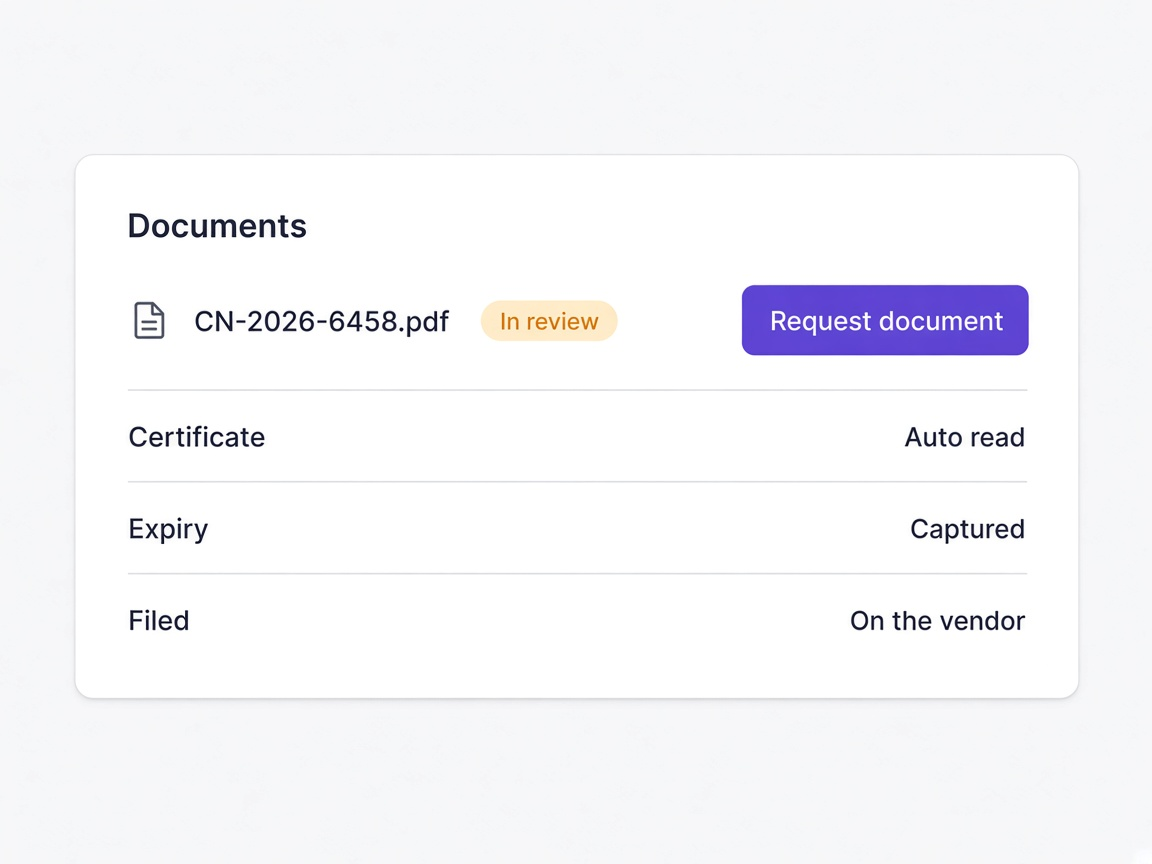
| The certificate itself | Uploaded as part of the questionnaire, so the evidence sits with the claim |
| The expiry date | Certifications expire. A classification supported by a lapsed certificate is a reporting problem waiting to surface |
Three recurring problems
| Problem | Consequence |
|---|---|
| Classification inferred from supplier names | Slow, partly accurate, impossible to verify properly, and it has to be redone every reporting period |
| Certificates collected but not tracked to expiry | Suppliers continue to count toward reported figures on the basis of certifications that have since lapsed |
| Certified and self-declared reported together | A total that cannot be broken down by basis is difficult to defend the first time somebody asks how it was derived |