W-9 vs W-8BEN
Which form from which vendor
Requesting the wrong tax form is the most common avoidable delay in vendor onboarding. The rule itself is simple. The mistake is asking every vendor for the same thing and letting them work it out.
Request a W-9 from US persons, which includes US citizens, resident aliens and entities formed in the United States. Request a W-8BEN from foreign individuals and a W-8BEN-E from foreign entities. The determining factor is the vendor's US tax status rather than where they happen to be located or invoice from.
Status decides the form
Ask the vendor a single question about their tax status and the correct form follows from the answer. That one branch removes most of the confusion.
| Vendor | Form | Purpose |
|---|---|---|
| US individual or sole proprietor | W-9 | Provides the taxpayer identification number and certifies US person status |
| US entity such as an LLC or corporation | W-9 | Same purpose, completed by the entity rather than an individual |
| Foreign individual | W-8BEN | Certifies foreign status and claims any applicable treaty benefits |
| Foreign entity | W-8BEN-E | The entity version, which is considerably longer and asks about entity classification |
| Foreign intermediary or flow-through | Other W-8 series forms | Less common, and worth confirming with your tax advisers rather than guessing |
Four patterns worth avoiding
Asking for both and letting the vendor choose
This looks helpful and produces confusion, wrong submissions and support email. Ask one question about status and send the form that follows.
Using location rather than status
A vendor invoicing from overseas may still be a US person, and a vendor with a US address may not be. Status is the determining factor, not the billing address.
Treating W-8BEN and W-8BEN-E as interchangeable
W-8BEN is for individuals, W-8BEN-E is for entities. The entity version is substantially longer, and sending the wrong one means starting again.
Collecting the form after onboarding
Requesting it separately once finance notices it is missing is what turns a two minute task into a three week thread. Make it part of the questionnaire.
One question, three outcomes
This is the entire logic, and it is worth building once rather than explaining repeatedly.
| If the vendor answers | Then request |
|---|---|
| US person, individual or entity | W-9 |
| Not a US person, and an individual | W-8BEN |
| Not a US person, and an entity | W-8BEN-E |
| Unsure | Route to your tax contact rather than guessing, and record that you did |
Things worth knowing before you build it
| Point | Detail |
|---|---|
| Forms expire differently | W-8 series forms generally have a validity period, so they need tracking to expiry in the same way as an insurance certificate. A W-9 does not expire in the same way but should be refreshed when details change |
| Details change | A change of entity name, address or taxpayer identification number means a fresh form rather than an amended record |
| This is not tax advice | The general rule is straightforward, but classification questions on the W-8BEN-E in particular are genuinely technical. Confirm edge cases with your tax advisers |
About vendor tax forms
What is the difference between a W-9 and a W-8BEN?
Which vendors need a W-9?
What is the difference between W-8BEN and W-8BEN-E?
Does the vendor's location decide the form?
Can we just ask every vendor for both?
Do these forms expire?
Is this tax advice?
Where to go next
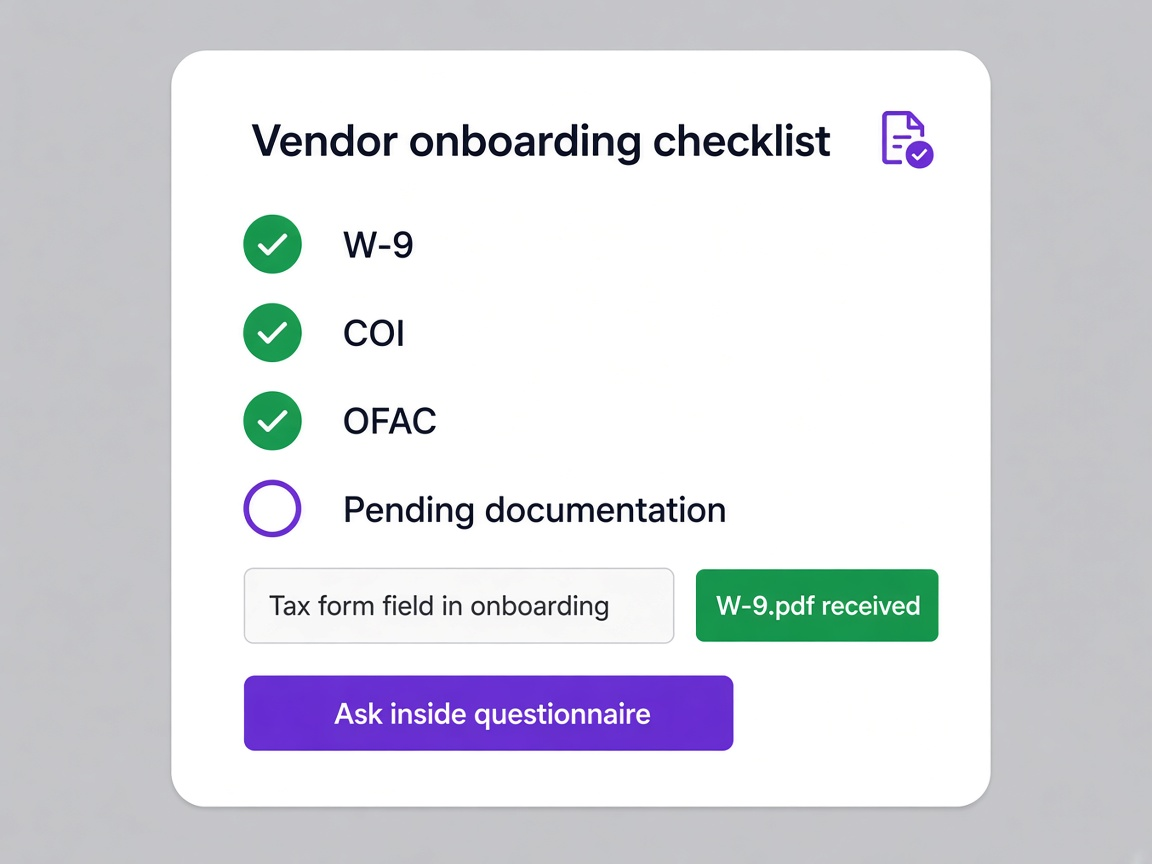
Collecting W-9 forms automatically
Making the tax form part of the questionnaire rather than a follow-up email.
Read more